


Executing stainless steel import procedures requires enterprises to possess a firm grasp of foreign trade knowledge and current regulations on quality inspection. This article provides a detailed roadmap spanning HS codes, tax rates, and practical customs clearance processes for all types of stainless steel.
An Overview of Stainless Steel Import Policies
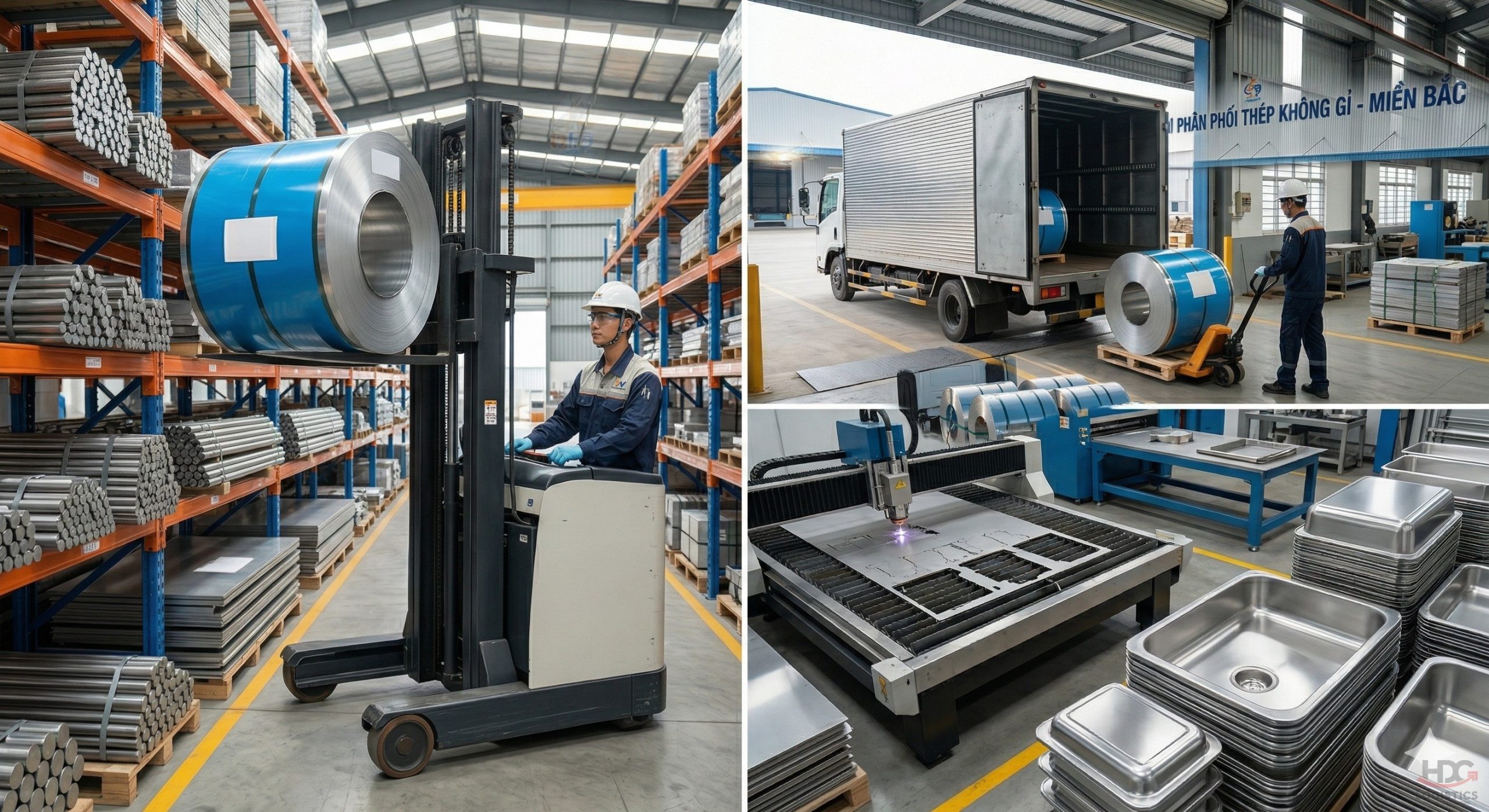
Stainless steel (inox) is a vital commodity serving construction and industrial manufacturing needs in Vietnam. Currently, this item is not on the list of prohibited imports, allowing enterprises to be more proactive in sourcing international supplies.
However, the stainless steel import process must strictly comply with legal documents such as Circular 38/2015/TT-BTC (amended by 39/2018/TT-BTC) and Decree 69/2018/NĐ-CP. These regulations ensure transparency and safety for the domestic market.
Enterprises should note that if importing used steel in the form of scrap, a specialized permit is mandatory. Correctly identifying management policies from the outset will help minimize legal risks later on.
Identifying HS Codes and Import Taxes for Stainless Steel
Determining the HS (Harmonized System) code is the most critical step to calculate costs and understand tax policies. The HS code for stainless steel usually resides in Chapter 72, depending on technical specifications such as shape, size, and surface treatment.
| HS Code | Description |
|
Stainless steel in ingots or other primary forms; semi-finished products of stainless steel
|
|
| 72181000 |
– In ingots and other primary forms |
|
– Other: |
|
| 72189100 |
– – Of rectangular (other than square) cross-section |
| 72189900 |
– – Other |
|
Flat-rolled products of stainless steel, of a width of 600 mm or more
|
|
|
– Not further worked than hot-rolled, in coils: |
|
| 72191100 |
– – Of a thickness exceeding 10 mm |
| 72191200 |
– – Of a thickness of 4.75 mm or more but not exceeding 10 mm |
| 72191300 |
– – Of a thickness of 3 mm or more but less than 4.75 mm |
| 72191400 |
– – Of a thickness of less than 3 mm |
|
– Not further worked than hot-rolled, not in coils: |
|
| 72192100 |
– – Of a thickness exceeding 10 mm |
| 72192200 |
– – Of a thickness of 4.75 mm or more but not exceeding 10 mm |
| 72192300 |
– – Of a thickness of 3 mm or more but less than 4.75 mm |
| 72192400 |
– – Of a thickness of less than 3 mm |
|
– Not further worked than cold-rolled (cold-reduced): |
|
| 72193100 |
– – Of a thickness of 4.75 mm or more |
| 72193200 |
– – Of a thickness of 3 mm or more but less than 4.75 mm |
| 72193300 |
– – Of a thickness exceeding 1 mm but less than 3 mm |
| 72193400 |
– – Of a thickness of 0.5 mm or more but not exceeding 1 mm |
| 72193500 |
– – Of a thickness of less than 0.5 mm |
| 72199000 |
– Other |
| 7220 |
Flat-rolled products of stainless steel, of a width of less than 600 mm
|
|
– Not further worked than hot-rolled: |
|
| 722011 |
– – Of a thickness of 4.75 mm or more: |
| 72201110 |
– – – Hoop and strip (SEN), of a width not exceeding 400 mm |
| 72201190 |
– – – Other |
| 722012 |
– – Of a thickness of less than 4.75 mm: |
| 72201210 |
– – – Hoop and strip (SEN), of a width not exceeding 400 mm |
| 72201290 |
– – – Other |
| 722020 |
– Not further worked than cold-rolled (cold-reduced): |
| 72202010 |
– – Hoop and strip (SEN), of a width not exceeding 400 mm |
| 72202090 |
– – Other |
| 722090 |
– Other: |
| 72209010 |
– – Hoop and strip (SEN), of a width not exceeding 400 mm |
| 72209090 |
– – Other |
| 72210000 |
Bars and rods, hot-rolled, in irregularly wound coils, of stainless steel |
|
Other bars and rods of stainless steel; angles, shapes and sections of stainless steel
|
|
|
– Bars and rods, not further worked than hot-rolled, hot-drawn or extruded: |
|
| 72221100 |
– – Of circular cross-section |
| 72221900 |
– – Other |
| 722220 |
– Bars and rods, not further worked than cold-formed or cold-finished: |
| 72222010 |
– – Of circular cross-section |
| 72222090 |
– – Other |
| 722230 |
– Other bars and rods: |
| 72223010 |
– – Of circular cross-section |
| 72223090 |
– – Other |
| 722240 |
– Angles, shapes and sections: |
| 72224010 |
– – Not further worked than hot-rolled, hot-drawn or extruded |
| 72224090 |
– – Other |
| 7223 |
Stainless steel wire
|
| 72230010 |
– Of a cross-sectional dimension exceeding 13 mm |
| 72230090 |
– Other |
Calculating Stainless Steel Import Duties
Import duties are mandatory obligations that enterprises must complete with the state budget. The specific tax amount is calculated based on the CIF value (cost of goods plus insurance and freight to the first port of entry). The tax calculation formulas are applied as follows:
Import duty, determined by the HS code import duty rate, is calculated using the formula:
Import VAT is determined using the formula:
Typically, the VAT rate for stainless steel is 10%. To enjoy special preferential tax rates, enterprises must provide a valid Certificate of Origin (C/O) from countries that have trade agreements with Vietnam.
Quality Inspection Process for Imported Stainless Steel
The majority of raw steel items, when imported, must undergo quality inspection in accordance with regulations set by the Ministry of Science and Technology (MOST). This is a prerequisite condition for goods to be permitted for circulation.
The quality inspection process consists of 3 basic steps:
-
Step 1: Register the quality inspection profile on the National Single Window system (vnsw.gov.vn). Enterprises must have a valid account to input data and track results.
-
Step 2: Sampling and practical testing. Enterprises contact authorized testing bodies licensed by the Ministry of Science and Technology to perform sample tests.
-
Step 3: Update results onto the system. Upon receiving the compliance certificate, results will be uploaded to the portal to complete the customs profile.
Documentation Required for Stainless Steel Import Procedures
To ensure a smooth customs clearance process, enterprises need to prepare a full set of documentation in compliance with Circular 38/2015/TT-BTC. Preparing paperwork in advance helps avoid port detention scenarios that generate unexpected costs.
A standard customs dossier includes:
-
Import customs declaration.
-
Foreign trade contract (Sales Contract).
-
Commercial Invoice.
-
Packing List.
-
Ocean Bill of Lading or Air Waybill.
-
Certificate of Origin (C/O) to enjoy tax incentives.
-
Confirmed quality inspection registration form.
Practical Customs Clearance Process for Stainless Steel
The stainless steel import process is standardized across 4 phases to ensure accuracy and compliance with prescribed time limits.
Step 1: Customs Declaration Submission
Enterprises use ECUS/VNACCS software to transmit data to the customs system. This must be executed within 30 days of the cargo’s arrival at the port to avoid administrative penalties.
Step 2: Customs Dossier Submission and Examination
Based on the routing results (Green, Yellow, Red), the enterprise brings the physical dossier down to the customs branch for comparison. This step must be carried out within 15 days after submitting the customs declaration.
Step 3: Cargo Clearance Approval
Once customs officers inspect and accept the dossier, the enterprise proceeds to pay taxes to receive the customs clearance decision. In certain cases, goods may be released to storage warehouses for preservation prior to completing full procedures.
Step 4: Picking Up Cargo and Gate-Out
The enterprise prepares the Delivery Order (D/O) and transport vehicles to retrieve the cargo through the port’s supervision area. Ensure that all documentation has been fully liquidated.
Important Notes When Importing Stainless Steel
During execution, misclassifying HS codes is the most common risk, which can lead to delivery delays or administrative fines ranging from 2,000,000 VND up to 3 times the evaded tax amount.
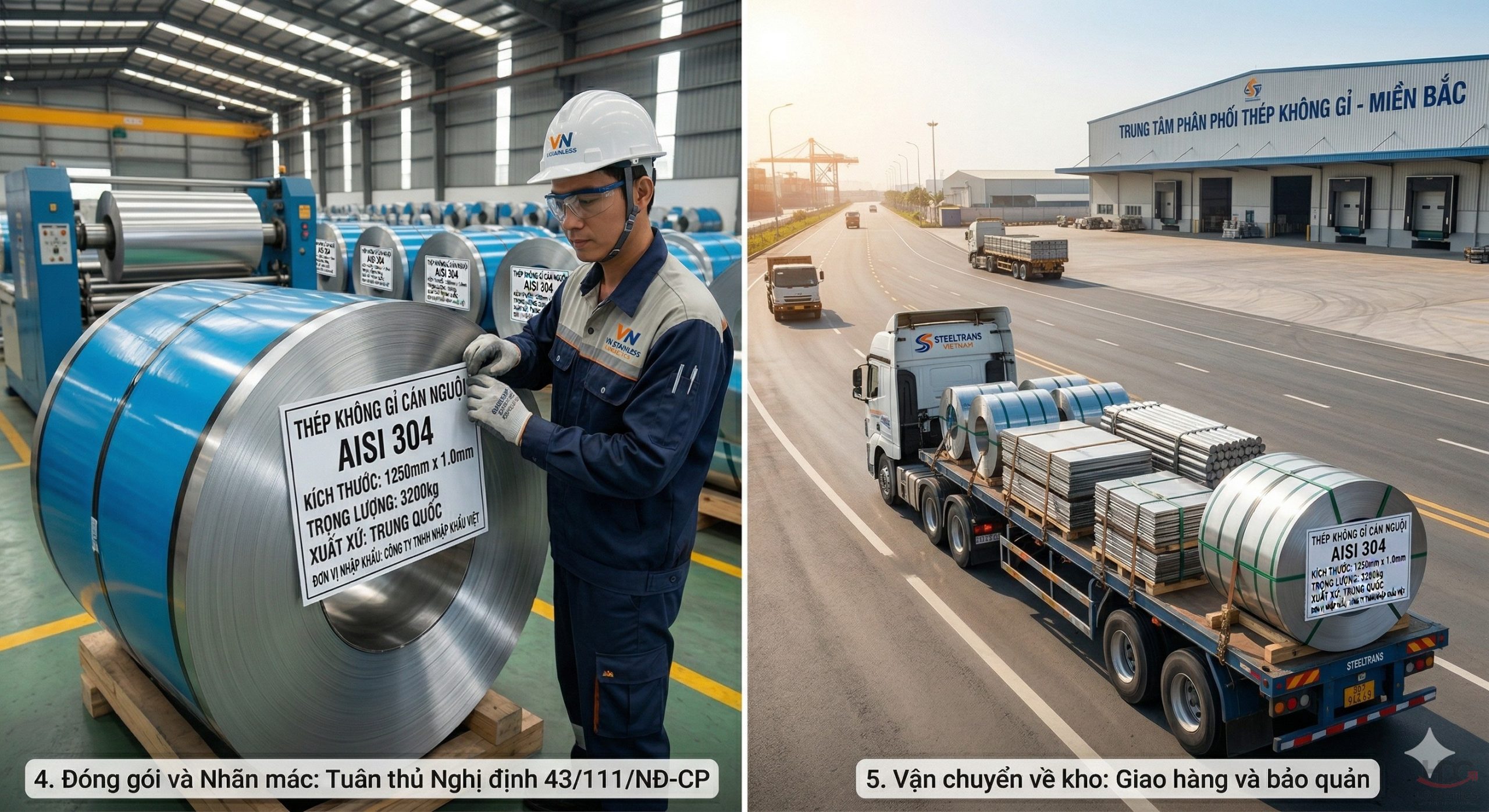
Additionally, enterprises must pay attention to labeling goods in accordance with Decree 43/2017/NĐ-CP. Labels must fully display information regarding origin, the importing entity, and technical specifications to avoid penalties during post-clearance audits.
Finally, always stay updated on regulations regarding anti-dumping duties and safeguard duties targeting steel from certain specific markets. Double-checking thoroughly before signing a contract will help you accurately project input costs.
This article has compiled the entire process and necessary documentation for stainless steel import procedures. It is hoped that these specialized insights will help your enterprise conduct import-export activities in the safest and most efficient manner.



 Tiếng Việt
 日本語
 中文 (中国)