

Generators serve as essential standby energy equipment for manufacturing plants, industrial zones, and construction works. Thoroughly understanding specialized regulatory policies helps enterprises accurately forecast costs and prevent port storage risks. This article outlines the step-by-step generator import procedures tailored for international trade enterprises.

Regulatory Policies on Generator Imports
Under current regulations, 100% brand-new generators are not listed under prohibited export or import goods. Enterprises are permitted to declare import entries identical to conventional commercial merchandise.
Regarding importing used generators, the equipment falls under the regulatory scope of Prime Minister Decision No. 18/2019/QD-TTg. The operational age of imported used units must not exceed 10 years, calculated from the year of manufacture to the year of declaration opening. Importers are legally required to perform an equipment condition appraisal inspection before departure or directly upon arrival at the destination port of entry.
Furthermore, imported generators must rigorously comply with mandatory goods labeling requirements under Decree No. 43/2017/ND-CP and Decree No. 111/2021/ND-CP. Equipment nameplates must legibly state the commercial name, country of origin, manufacturing year, rated power capacity, and working voltage.
Generator HS Code and Import Duty Schedule
Accurately determining the generator HS code is the most critical technical step across the entire customs clearance workflow. Based on rated capacity (kVA), current output type (AC or DC), and prime mover engine mechanism (diesel, petrol, or gas), generators are categorized into specific heading codes.
Generator commodities primarily fall under two main headings in Chapter 85 of the import-export tariff schedule:
-
Heading 8501: Alternating current generators (dynamos/alternators), not incorporating a driving prime mover engine.
-
Heading 8502: Generating sets (combining an internal combustion engine coupled with an electric generator) and rotary converters.
Reference Table: Common Generating Set HS Codes and Taxes
| Equipment Classification | HS Code | Preferential Import Duty | VAT |
|
Diesel generating sets not exceeding 75 kVA |
8502.11.00 |
0% – 5% |
8% – 10% |
|
Diesel generating sets exceeding 75 kVA but not exceeding 125 kVA |
8502.12.10 |
0% |
8% – 10% |
|
Diesel generating sets exceeding 125 kVA but not exceeding 375 kVA |
8502.12.20 |
0% |
8% – 10% |
|
Diesel generating sets exceeding 375 kVA |
8502.13.90 |
0% |
8% – 10% |
|
Petrol-driven generating sets not exceeding 7.5 kVA |
8502.20.10 |
10% |
8% – 10% |
|
Petrol-driven generating sets exceeding 7.5 kVA |
8502.20.20 |
5% |
8% – 10% |
|
AC generators (alternators) not exceeding 75 kVA |
8501.61.10 |
0% – 3% |
8% – 10% |
(Note: The above duty rates reflect standard preferential schedules. Enterprises presenting valid Certificates of Origin (C/O) are eligible for a 0% special preferential generator import duty under free trade agreements such as ACFTA, AJCEP, EVFTA, VKFTA, or ATIGA).
Step-by-Step Generator Import Clearance Workflow
Clearing generator consignments demands thorough coordination from engineering parameter reviews to physical port pickup. Documentation and field operations teams must coordinate tightly to protect operational timelines.
Step 1: Technical Parameter Verification and Equipment Lifespan Assessment
The importer requests the supplier to send technical catalogues and structural layout drawings in advance. The catalogue specifications must indicate model numbers, prime power, standby power, and the manufacturing year. When importing used generators, check the physical nameplate to confirm the unit does not exceed the statutory 10-year limit.
Step 2: Appraisal Registration for Used Equipment (If Applicable)
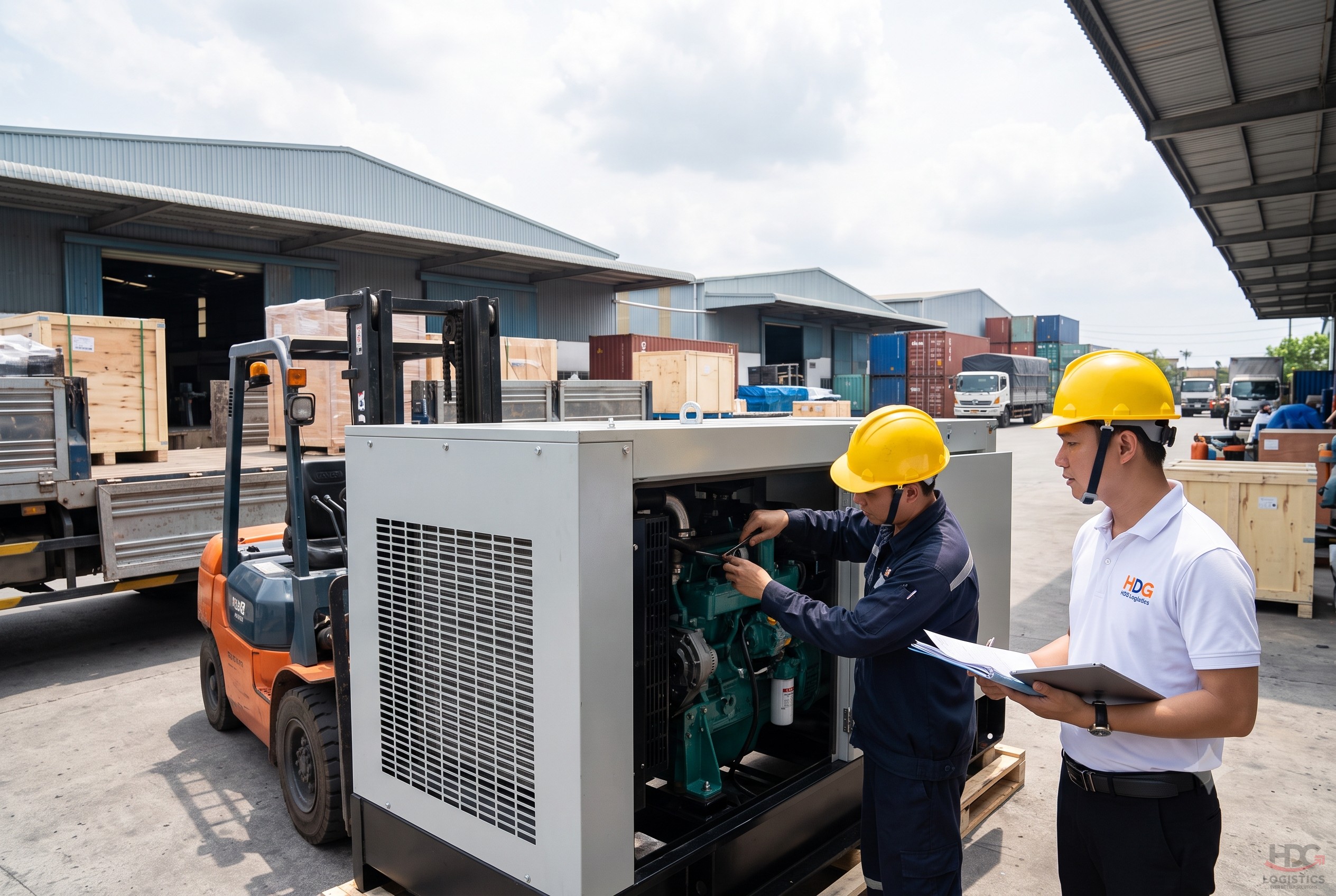
For secondhand units, the importer registers an appraisal application with an inspection body accredited by the Ministry of Science and Technology. Inspectors examine the equipment on-site at the port or client bonded storage. The resulting inspection certificate confirming operational stability and compliance with Decision 18/2019/QD-TTg serves as the prerequisite for customs release.
Step 3: Dossier Collation and Electronic Declaration Transmission
The enterprise uses ECUS5-VNACCS declaration software to transmit consignment details. Declarations must reflect the equipment brand, serial number, model, kVA power capacity, and dutiable values. Following electronic transmission, the customs automated system assigns a channel routing result.
Step 4: Declaration Opening and Customs Document Inspection
Depending on the automated channel assignment, customs clearance proceeds as follows:
-
Green Channel: The enterprise settles tax obligations and generates container release barcodes to retrieve cargo directly.
-
Yellow Channel: Customs officers review physical/electronic dossiers in detail. With compliant paperwork and no valuation or tariff doubts, clearance is granted.
-
Red Channel: Customs officers execute physical inspections at the port inspection yard, matching serial numbers, chassis plates, and product labels against declared documentation.
Step 5: Duty Payment and Cargo Gate-Out Release
The importer settles import duty and value-added tax via the electronic bank payment gateway. Once the customs portal confirms tax deduction, the entry status converts to cleared. The company liquidates the entry at port surveillance and deploys specialized vehicles to pull the cargo to the warehouse.
Customs Dossier Requirements for Generator Imports
The customs dossier for importing generators is compiled pursuant to Circular 38/2015/TT-BTC and amended Circular 39/2018/TT-BTC. Enterprises must maintain digitally signed electronic copies or original dossiers for customs verification:
-
Electronic import customs declaration.
-
Commercial Invoice.
-
Packing List.
-
International Sales Contract.
-
Bill of Lading or Air Waybill.
-
Certificate of Origin (C/O Form E, Form D, Form AK, Form EUR.1…) if claiming duty preferences.
-
Manufacturer Technical Specifications / Data Sheet.
-
Used equipment age appraisal certificate (mandatory for used machinery).
Critical Notes When Handling Generator Imports
Importers frequently encounter compliance hurdles regarding power conversions and physical inspection matching. Take note of these key technical details:
Power Unit Conversions
Foreign manufacturers frequently rate output capacities in kW instead of kVA. Under the national import tariff schedule, classifications under Headings 8501 and 8502 require kVA metrics. Convert kW values to kVA using the equipment power factor (typically $\cos\varphi = 0.8$) to avoid applying the wrong generator HS code.
Port-of-Entry Equipment Nameplates
Nameplates on the alternator housing and prime mover must be riveted securely or cleanly stamped in metal. Mandatory markings include: manufacturer name, production year, country of origin, serial numbers, rated output, and operational voltage. Discrepancies between the physical nameplate and invoice documentation trigger Red channel re-routing and administrative fines.
Logistics Planning for Heavy and Oversized Cargo
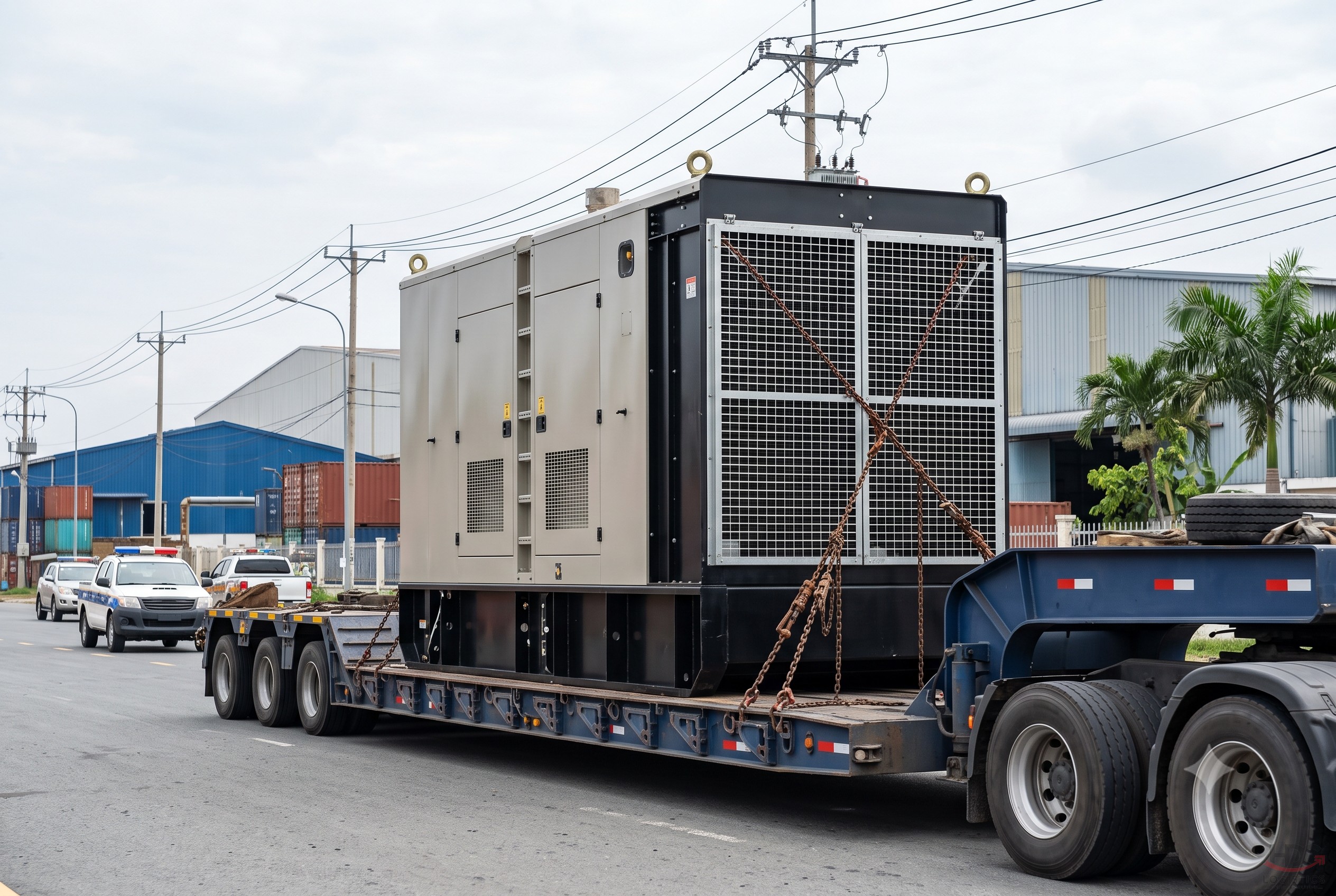
Industrial generating sets possess heavy structural mass and bulky footprints reaching tens of tons. Consignments are hauled via Flat Rack or Open Top container equipment, or via breakbulk vessels. Survey inland highway clearances and axle-load allowances from the port to the plant prior to vessel arrival to avoid delivery delays.
Frequently Asked Questions (FAQ)
Do 100% brand-new generators require energy efficiency testing?
Under Decision 14/2023/QD-TTg and Decision 1725/QD-BCT, minimum energy performance standards (MEPS) and energy labeling apply strictly to standalone electric motors. Complete generating sets powered by diesel or petrol (Heading 8502) imported as unified units are currently exempt from energy labeling requirements.
Is importing used generators older than 10 years permitted?
No. Pursuant to Article 6 of Decision 18/2019/QD-TTg, used machinery exceeding 10 years of age is strictly disqualified from entering Vietnam for production purposes. Enterprises are only allowed to clear used units manufactured within the past 10 years supported by certified appraisal reports.
Can enterprises receive tariff reductions when importing generators from China?
Yes. Presenting a valid C/O Form E grants a 0% special preferential generator import duty for most 8502 generating sets. The importer only pays the standard Value-Added Tax (VAT) rate.
Handling generator import procedures accurately minimizes container storage expenses, safeguards construction schedules, and maintains trade compliance. HDG Logistics provides end-to-end support ranging from technical classification to on-site port customs handling.


 Tiếng Việt
 日本語
 中文 (中国)